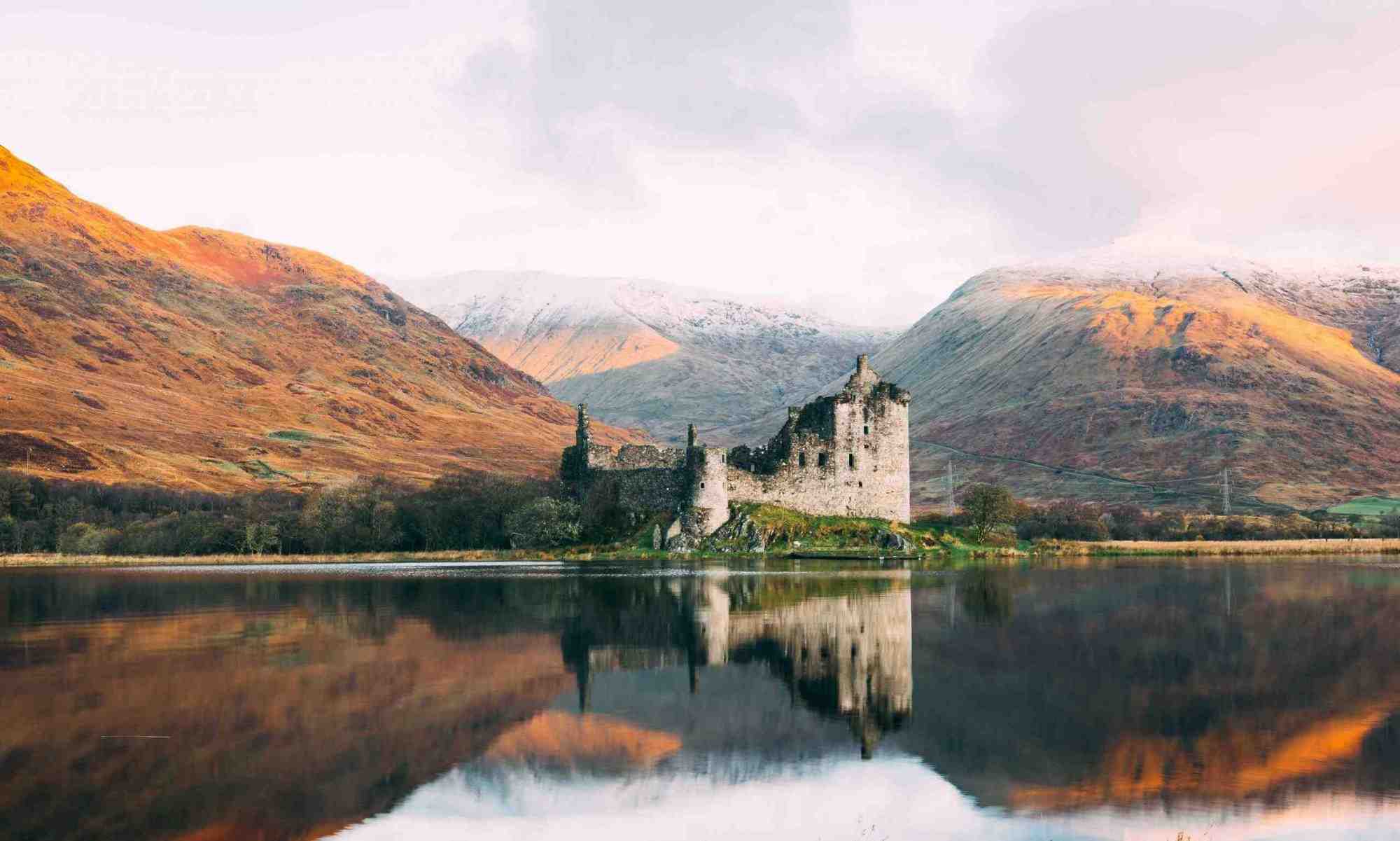

Castle Campbell and Dollar Glen
Castle Campbell stands on a rocky spur at the head of Dollar Glen in the Ochil Hills, with a wooded gorge falling away on either side and a view south across the Forth valley that stretches to the Pentlands. It is one of the most dramatically sited castles in Scotland, and one of the most enjoyable to reach – the approach through the glen, on paths and bridges above a series of waterfalls, is as good as the castle itself.
It was the Lowland stronghold of the Campbell earls of Argyll, it heard John Knox preach, it was burned in the wars of the 1650s, and it is now in the care of Historic Environment Scotland. This guide covers the history, what there is to see, the walk up through Dollar Glen, and how to plan a visit.
Castle Gloom: the name
The castle was originally called Castle Gloom, a name probably derived from an older Gaelic or Scots word for a chasm or hollow rather than from anything melancholy. It sits between two streams called the Burn of Care and the Burn of Sorrow, above the village of Dollar – a coincidence of names so improbably bleak that visitors have been remarking on it for centuries.
In 1489, Colin Campbell, 1st Earl of Argyll, obtained an Act of Parliament to change the name to Castle Campbell, marking the family’s arrival as a national power with a seat within reach of the royal court at Stirling. Locally, the old name never quite went away.
A short history
The oldest part of the castle is the great tower house, built in the late 15th century: a tall, plain rectangular block with vaulted cellars, a hall above and private chambers over that. The Campbells added ranges around a courtyard through the 16th and early 17th centuries, turning a fortress into a residence – including an unusual arcaded loggia along the east range, a piece of Renaissance architecture rare in Scotland.
The castle’s position mattered. From the Ochils the Campbells could reach Stirling in a morning, which put them close to power without abandoning their Argyll heartland. Their story is set out further in our pages on Inveraray, the family’s west-coast seat.
In 1556 John Knox, the leading figure of the Scottish Reformation, is recorded as preaching at Castle Campbell as a guest of the earl – a reminder that the Campbells were early and committed supporters of the Protestant cause.
The wars of the mid-17th century ended the castle’s useful life. The Marquis of Argyll’s prominence on the Covenanting side made his properties a target, and Castle Campbell was attacked and burned during the campaigns of the 1640s and 1650s, with Cromwellian troops also garrisoning the site. It was never fully restored, and by the 18th century it was a romantic ruin admired by travellers – which is more or less what it remains.
What you see today
Rather more than most ruins of its age. The great tower survives to its full height and can be climbed, which is the highlight of a visit.
- The vaulted basement – the lowest chamber of the tower, with a pit prison off it, cold and windowless.
- The great hall – on the first floor of the tower, with a fireplace and window seats, and a sense of the scale on which the earls entertained.
- The upper chambers and roof – a turnpike stair climbs to the parapet, where the view over Dollar, the Forth valley and the Ochils is the reason to make the trip.
- The loggia – the arcaded gallery on the east range, a piece of continental fashion transplanted to a Scottish hillside.
- The courtyard and terraced gardens – laid out on the slopes below the walls, with paths giving views back up at the castle.
It is a compact site. Allow 45 minutes to an hour inside, longer if you sit on the terrace and take in the view, and considerably longer if you walk up through the glen.
Dollar Glen
The glen below the castle is in the care of the National Trust for Scotland and is, for many visitors, the better half of the day. The Burn of Care and the Burn of Sorrow meet in a narrow, wooded gorge, and a path threads up through it on wooden walkways, stone steps and footbridges, past waterfalls and mossy rock walls.
The full walk from the centre of Dollar village to the castle takes roughly 45 minutes uphill and is steep in places, with steps and some exposed sections above the burn. It is muddy and slippery after rain, and the path is occasionally closed for repairs after storm damage – check before you set out. Wear boots or grippy shoes; this is not a trainers-and-a-pushchair route.
If you would rather not do the climb, there is a small car park close to the castle at the top of the glen, reached by a narrow single-track road out of Dollar. It fills quickly on fine weekends, and the last stretch is not suitable for large vehicles.
Walks beyond the castle
The Ochils rise directly behind the castle and offer good hill walking with far less traffic than the Trossachs or the Highlands. From the top of the glen, paths climb onto Whitewisp Hill and Tarmangie Hill, and a longer circuit takes in King’s Seat Hill, the highest ground above Dollar. These are proper hills – navigation, weather and daylight all need thinking about – but the reward is a view over the whole Forth valley with the castle far below.
For an easier option, the woodland paths in the lower glen make a pleasant hour on their own, and the village of Dollar has cafes and a good bakery for afterwards.
Planning your visit
- Managed by Historic Environment Scotland (the castle) and the National Trust for Scotland (the glen). An admission charge applies to the castle; members of either organisation should check what their card covers.
- Opening is seasonal, with reduced days in winter. Check the Historic Environment Scotland website before travelling – opening arrangements at HES properties have changed at short notice in recent years for masonry inspections.
- Getting there: Dollar is on the A91 between Stirling and St Andrews, about 25 minutes from Stirling and an hour from both Edinburgh and Glasgow. Buses serve Dollar from Stirling and Alloa; the nearest station is Alloa.
- Parking: a small car park near the castle, or park in Dollar and walk up through the glen.
- Accessibility: limited. The upper car park reduces the walk considerably, but the castle involves uneven ground, spiral stairs and steep drops. The glen path is unsuitable for wheelchairs and pushchairs.
- Facilities: minimal on site. Dollar village has shops, cafes and toilets.
- Dogs are welcome in the glen on a lead; check current policy for the castle grounds.
When to go
Late spring and autumn are the best times. In May the glen is at its greenest and the burns are usually still full; in October the beech and oak turn and the light is low across the Forth valley. Summer weekends are the busiest, and the small car park is the pinch point – arrive early. Winter visits can be spectacular after a frost, but check both the castle opening days and the state of the glen path.
Combining it with other places nearby
Castle Campbell sits in the middle of some of central Scotland’s best day-trip country:
- Stirling and the Forth Valley – the castle, the Wallace Monument and the whole Bannockburn story, 25 minutes west.
- The Falkirk Wheel and the Kelpies – half an hour south.
- Callendar House and the Antonine Wall – Roman and Georgian Falkirk.
- Dunfermline and the Kingdom of Fife – east over the hills.
- Blair Drummond Safari Park – the obvious add-on if you have children.
For more in this vein, see our roundup of the best castles in Scotland.
Dollar and the Hillfoots villages
Dollar itself is worth twenty minutes before or after the castle. It is a neat Victorian town built around Dollar Academy, an imposing William Playfair school building that looks like a Greek temple dropped into Clackmannanshire, and it has cafes, a bakery and a couple of pubs along the main street.
Dollar is one of the Hillfoots villages – a string of settlements including Tillicoultry, Alva and Menstrie strung along the base of the Ochil escarpment on the A91. All of them grew on wool and weaving, powered by the burns pouring off the hills, and each has its own glen walk climbing steeply behind it. Alva Glen and Tillicoultry’s Mill Glen are both short, dramatic and considerably less busy than Dollar Glen.
Photographing the castle
Castle Campbell rewards patience with a camera. The classic shot is from the path on the far side of the glen, looking across at the tower with the hills behind. Early morning often brings mist filling the valley below, with the castle standing clear above it. Late afternoon light from the south-west lifts the stonework and throws the Forth valley into layers of haze. Autumn, when the beeches in the glen turn, is the best month of the year for it.
Inside, the tower’s window embrasures frame the view neatly, and the loggia arcade gives strong lines and shadow on a bright day. Bring something wide; the courtyard is tight.
A note on Clackmannanshire
The castle sits in Clackmannanshire, Scotland’s smallest mainland county, tucked between the Ochils and the Forth. It is easy to overlook entirely – but along with Castle Campbell it holds Alloa Tower, one of the largest surviving medieval tower houses in Scotland and once home to the Erskine earls of Mar, who raised several Scottish monarchs. Combined, the two make a good half-day of castle-going within twenty minutes of each other.
What to bring
Castle Campbell is a hill site with a gorge walk attached, so pack accordingly. Footwear with grip is the main thing – the glen path has wooden walkways and stone steps that stay slick long after rain, and the castle’s spiral stair is worn smooth in places. A waterproof jacket is sensible in any month; the Ochils catch weather coming up the Forth. Bring water and a snack, because there is no cafe on site, and cash or a card for the admission charge.
If you are walking up from Dollar, allow an hour each way rather than the signposted 45 minutes, especially with children. Daylight matters in winter: the glen is dark under the trees by mid-afternoon in December, and it is not a path you want to descend in poor light.
One last practical note: there is no mobile signal to speak of in the bottom of Dollar Glen, and only patchy coverage at the castle itself. Download directions and any tickets before you leave the village, and if you are walking as a group, agree where to meet rather than assuming you can call each other on the way up. It is a small thing, but the glen is steep-sided and easy to get separated in.
Frequently asked questions
Why is it called Castle Gloom? The name is older than the Campbells and probably derives from a word for a chasm or hollow rather than from gloom in the modern sense. It was formally renamed Castle Campbell in 1489.
Can you walk to Castle Campbell from Dollar? Yes – about 45 minutes uphill through Dollar Glen on a steep, stepped path with bridges and waterfalls. There is also a small car park near the castle.
How long does a visit take? About an hour for the castle, or half a day if you walk up through the glen and back.
Is Castle Campbell open all year? It operates a seasonal timetable with reduced winter opening. Check Historic Environment Scotland before travelling.
Is it suitable for children? Yes, with supervision. Children generally love the tower, the stairs and the waterfalls, but there are steep drops in the glen and unguarded heights at the castle.
Did Mary, Queen of Scots visit? The Campbells were closely connected with the court, and the castle received notable visitors of the period, John Knox among them. Treat the more colourful local claims with the caution that Scottish castle folklore generally deserves.