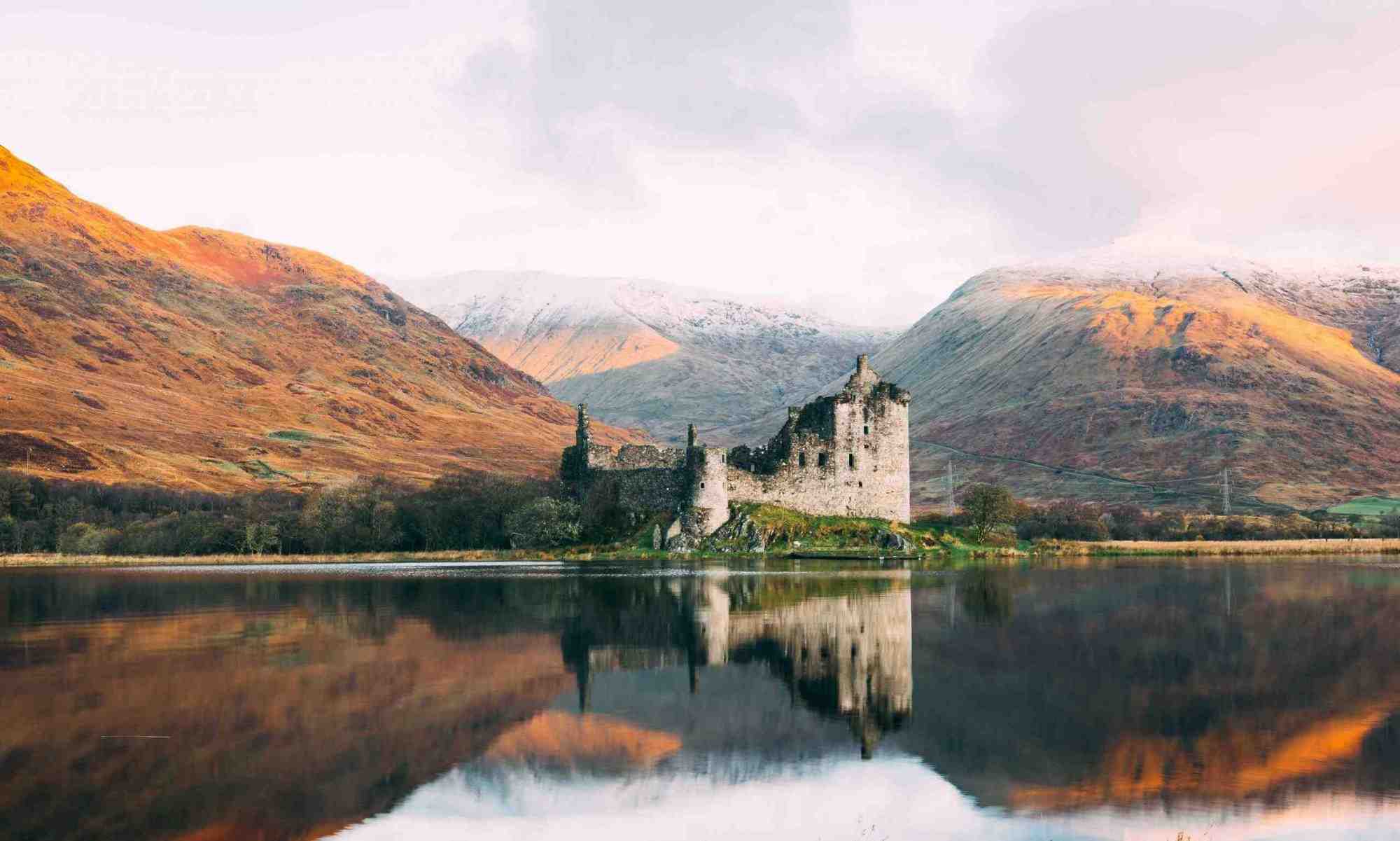

Lismore is a long, low, green island lying in Loch Linnhe between Oban and the mountains of Morvern and Appin. It is about ten miles from end to end and barely a mile across at most points, and it is one of the quietest places you can reach easily from the Scottish mainland — a short ferry from Oban or a five-minute crossing from Port Appin.
The name comes from the Gaelic Lios Mòr, usually translated as “the great garden”. Unlike most Hebridean islands, Lismore sits on limestone rather than acid rock, which makes its soil unusually fertile and its grass startlingly green against the grey and purple of the hills all around it.
Getting to Lismore
There are two crossings, and which you use makes a real difference to the day.
From Oban to Achnacroish — the CalMac vehicle ferry takes around fifty minutes and lands you in the middle of the island. This is the route to use if you want to bring a car, though on an island this size a car is more a convenience than a necessity.
From Port Appin to Point — a small passenger ferry crosses to the northern tip of the island in about five minutes. Foot passengers and bicycles only, no cars. It is the quicker and more charming option, and Port Appin is roughly half an hour north of Oban by road.
Both services run to timetables that change seasonally and are weather-dependent, and sailings are limited — this is not a route with hourly departures. Check the current timetable carefully and plan your return before you set off, because missing the last boat on Lismore is a genuine problem.
Getting around the island
Bring a bicycle. The island has effectively one road running its length, traffic is almost nonexistent, and the distances are ideal for cycling — you can ride the whole island in a day at a gentle pace with time to stop.
Walking is rewarding but the island is long, and covering it on foot means committing to one section rather than the whole. There is no regular bus, and taxi provision is minimal. If you arrive on the Port Appin ferry without a bike, plan on exploring the northern end only.
St Moluag and the cathedral
Lismore’s historical importance is out of all proportion to its size. In 562, St Moluag founded a monastery here — a year or so before Columba established Iona, and the two were rivals as much as colleagues in the conversion of Pictish Scotland.
Centuries later the island became the seat of the Bishops of Argyll, and the Cathedral of St Moluag was built here in the thirteenth century. What survives is the choir, reduced in height and adapted, now serving as the parish church. It is a modest building for a cathedral, and rather moving for it — you are standing in the mother church of a medieval diocese in a field on a small island.
The associated Bachuil, the pastoral staff of St Moluag, is still held on the island by the family who have been its hereditary keepers for generations. It is one of the very few relics of its kind in Scotland to have survived the Reformation in continuous private care.
Castles and the broch
Three ruins are worth the walk.
Castle Coeffin is a thirteenth-century MacDougall stronghold on the north-west coast, standing on a promontory above the water with the hills of Morvern behind. The setting is superb and the walk down to it from the road is short.
Achadun Castle, at the southern end, was the residence of the Bishops of Argyll, and though little is left the position — looking across to Mull — explains why they chose it.
Tirefour Broch is the pick of the three. It is an Iron Age drystone tower, one of the better-preserved brochs on the west coast, with walls still standing several metres high in places. It sits on a ridge with a wide view up and down Loch Linnhe, and getting there involves a walk across fields.
The Gaelic Heritage Centre
Ionad Naomh Moluag, the island’s heritage centre and museum, tells the story of Lismore’s people, its Gaelic culture and its crofting past. Next to it stands a restored nineteenth-century cottage furnished as it would have been lived in, which does more to convey island life than any amount of interpretation panel.
There is a café here, and this matters more than it sounds: facilities on Lismore are extremely limited. Opening is seasonal, so check before relying on it for lunch.
What Lismore is actually like
It is worth being clear about expectations. Lismore has a population in the low hundreds, one small shop, no pubs to speak of, no chain of anything, and no nightlife. It has no dramatic mountains of its own — it is a low island, and its beauty is in what surrounds it.
And what surrounds it is remarkable. From the spine of the island you look east to the Glencoe and Appin hills, north towards Ben Nevis, west to Morvern and Mull. On a clear day the combination of green foreground and mountain horizon in every direction is as good as anything on the west coast.
Wildlife is a large part of the appeal. Otters are regularly seen along the shore, seals haul out on the skerries, and the island is good for birds — buzzards, herons, divers offshore in winter, and eagles overhead from the surrounding mainland. The limestone grassland also supports orchids and other flowers that are scarce elsewhere in the Hebrides.
The limestone and the lost population
The limestone that makes Lismore green also made it industrial for a while. Lime was quarried and burned here through the eighteenth and nineteenth centuries and shipped out for building and for agriculture, and the remains of kilns and quarry workings are still visible near the shore at Sailean and elsewhere. It is an odd thing to come across on so quiet an island.
That industry, and the fertility of the land, once supported a population many times the present one — well over a thousand people in the early nineteenth century, against a few hundred today. Emigration, clearance for sheep and the long drift of people away from the islands emptied it, and the ruined croft houses scattered across the island are the visible record of that.
Walking past them is a large part of what Lismore feels like. It is not an empty landscape but a depopulated one, and the difference is worth noticing.
Best time to visit
May and June are ideal: long daylight, wildflowers on the limestone grassland, and the best chance of the clear weather that makes the mountain views work. July and August are warmer and busier, though “busy” on Lismore is a relative term. Ferries reduce in winter and some facilities close entirely.
Where to stay
Accommodation is limited to a handful of self-catering cottages and bed and breakfast places, and it books up well in advance for summer. There is no hotel.
Many people visit Lismore as a day trip from Oban or from Port Appin and stay on the mainland, which is the simpler option. If you do want to stay on the island, book early and bring supplies — you cannot rely on shopping locally.
Combining Lismore with the rest of Argyll
Oban is the natural base for a trip here, and from there the island fits easily alongside the rest of the west coast. Boats from Oban also reach Mull and, beyond it, Staffa and Fingal’s Cave. Inland, Glencoe is under an hour’s drive and Fort William and Ben Nevis a little beyond that.
Lismore makes a good contrast to those: where Glencoe is dramatic and busy, Lismore is quiet and horizontal. A day here between two days in the mountains is a genuinely restorative bit of itinerary planning.
Frequently asked questions
How do you get to Lismore?
By CalMac vehicle ferry from Oban to Achnacroish, around fifty minutes, or by small passenger ferry from Port Appin to the north end of the island, around five minutes. Timetables are seasonal and limited.
Do you need a car on Lismore?
No, and a bicycle is better. The island has one main road, very little traffic, and distances that suit cycling. Only the Oban ferry carries vehicles.
What does Lismore mean?
It comes from the Gaelic Lios Mòr, “the great garden” or “great enclosure”, a reference to the island’s unusually fertile limestone soil.
Can you visit Lismore as a day trip?
Yes, and most visitors do. The Port Appin crossing in particular makes a straightforward day out with a bike. Check return sailing times before you go.
Is there anywhere to eat on Lismore?
Very little. The café at the heritage centre is the main option and opens seasonally. Bring food and water with you rather than assuming you will find lunch.
How long do you need on Lismore?
A full day covers the island’s highlights by bike. Two or three days lets you walk it properly and see it in different weather, which on this coast means seeing quite different islands.