
Linlithgow Palace is the roofless shell of one of Scotland’s grandest royal residences, standing on a low green hill between Linlithgow Loch and the town’s high street in West Lothian. It was the birthplace of Mary, Queen of Scots, and it is one of the easiest major historic sites to reach from Edinburgh — around twenty minutes by train, with the station a short walk away.
What survives is a ruin, but an unusually complete and legible one. You can walk the courtyard, climb the stairs, stand in the Great Hall and look out from the windows the Stewart kings looked out of. It is managed by Historic Environment Scotland.
A royal palace, and the fire that ended it
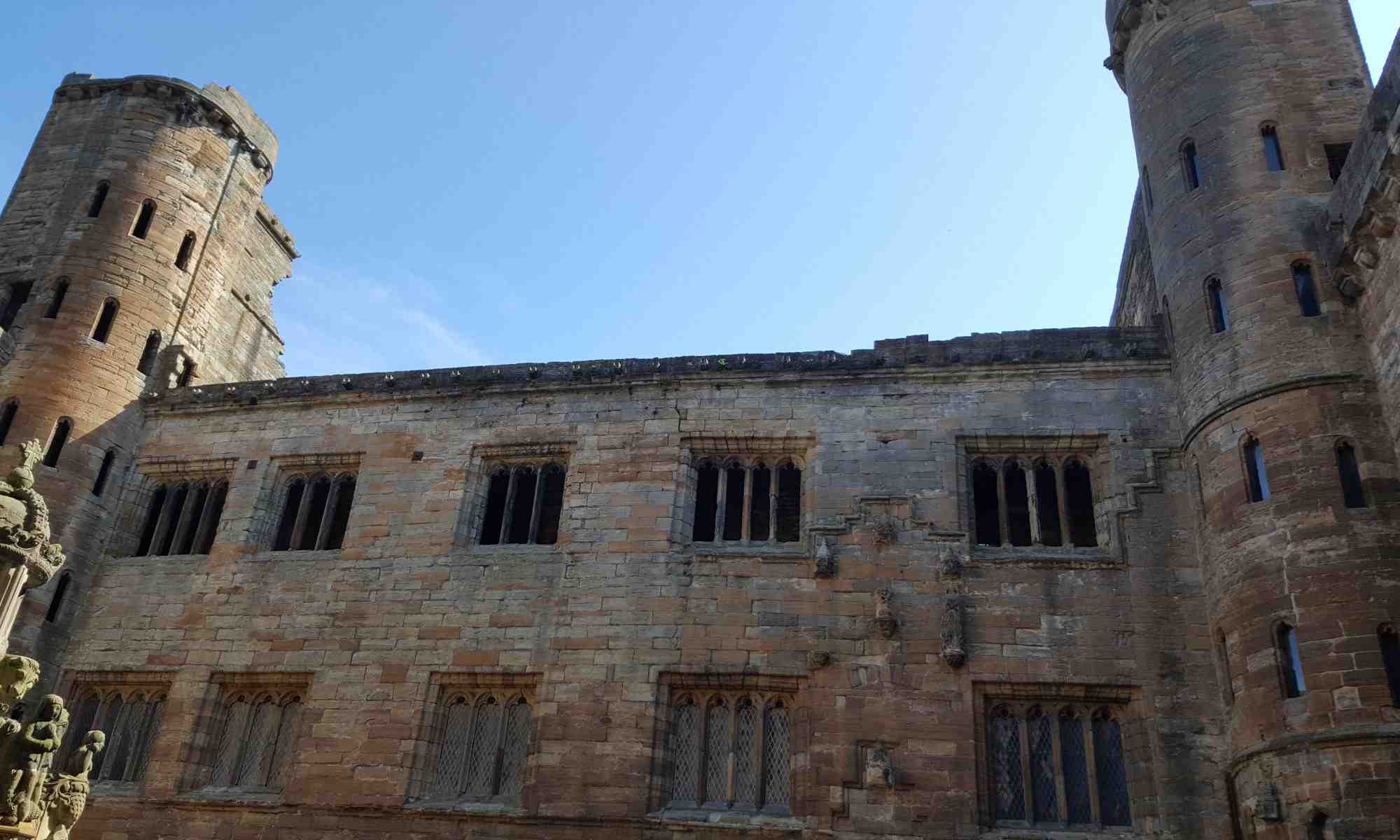
There has been a fortified residence on this site since the twelfth century, but the palace as it stands was largely the work of the Stewart kings from James I onwards in the fifteenth century, extended and improved by each of his successors.
James V was born here in 1512. His daughter Mary, Queen of Scots, was born here in December 1542 — six days before her father’s death made her queen at less than a week old. James V also commissioned the elaborate courtyard fountain, an extraordinary piece of Renaissance carving that still stands at the centre of the quadrangle and has been restored in recent decades.
The palace’s working life ended abruptly. In 1746, government troops quartered here during the Jacobite campaign left fires burning, and the building was gutted. It has been a roofless ruin ever since — which is precisely why so much of the original stonework survives unaltered by later rebuilding.
What to see
You enter from the town side and come out into the central courtyard with the fountain in the middle. From there the palace opens up around you in four ranges, and you can explore across several levels.
The highlights are the Great Hall, with its enormous fireplace and the scale of a room built to impress; the chapel; and Queen Margaret’s Bower, a small chamber at the top of a stair tower reached by a tight spiral. Tradition — probably romantic invention rather than fact — holds that Margaret Tudor watched from here for the return of James IV from Flodden. He never came back. The climb is worth it regardless for the view over the loch and the town.
Please note: the palace was closed entirely in 2021 after concerns about falling masonry, and reopened following extensive stabilisation work, with some routes managed by protective access corridors. At the time of writing the King’s Bed Chamber and the Court Kitchen remain closed for ongoing conservation. Other areas may close at short notice as work continues, so check the Historic Environment Scotland website before you travel if there is something specific you want to see.
Opening times and tickets
The palace operates summer and winter hours, opening earlier and closing later between April and September than it does over the winter months, with last entry around forty-five minutes before closing.
Rather than list figures that go out of date, we would point you to the official Historic Environment Scotland page for current opening times and admission prices. Entry is free for HES members and for Explorer Pass holders, which is worth considering if you are visiting several Scottish castles and abbeys on one trip.
Getting to Linlithgow Palace
By train — this is the easiest option and one of the best-connected historic sites in Scotland. Linlithgow sits on the main Edinburgh to Glasgow Queen Street line. Journey time is roughly twenty minutes from Edinburgh Waverley or Haymarket, and around forty minutes from Glasgow, with frequent services throughout the day. From the station it is a walk of a few minutes down into the town and up to the palace.
By car — Linlithgow is about twenty miles west of Edinburgh. Follow the M9 and leave at junction 3; coming from Stirling, leave at junction 4. There is parking in the town, though the streets immediately around the palace are limited.
By bus — regular services run through Linlithgow on the Edinburgh to Stirling and Falkirk routes.
Linlithgow Loch and the circular walk
Directly behind the palace lies Linlithgow Loch, and a circular path of roughly two and a half miles runs right around it. It is one of the best short walks in central Scotland, mainly because of the view back across the water to the palace and St Michael’s Church — the classic photograph of Linlithgow is taken from the far shore.
The path is surfaced near the palace and becomes rougher underfoot on the far side, so trainers or boots are better than smart shoes. Walking anticlockwise saves the best view of the palace for the second half. The loch is a designated nature reserve with swans, geese and a good range of waterfowl.
St Michael’s Parish Church
Immediately beside the palace stands St Michael’s, one of the largest medieval parish churches in Scotland and worth ten minutes of anyone’s time. The building is fifteenth-century, and it is topped by a startling aluminium crown spire added in 1964 in place of the medieval one removed in the nineteenth century. Opinion in the town has never entirely settled on it, which is part of the fun.
The town of Linlithgow
Linlithgow itself is an old royal burgh and deserves more than the walk between the station and the palace. The High Street runs along the line of the medieval road with a good stock of seventeenth- and eighteenth-century frontages, and the town has kept a genuine working centre rather than becoming a purely tourist stop.
The Union Canal passes to the south of the town, and the Linlithgow Union Canal Society runs a small canal museum and seasonal boat trips from the basin at Manse Road. It is an easy addition to a day here, particularly with children.
There are cafés, bakeries and pubs along the High Street, and enough choice that you will not need to plan lunch in advance. The town is compact and everything of interest is within a ten-minute walk of everything else.
Photographing the palace
The best-known view is from the north shore of the loch, looking back across the water with the palace and St Michael’s crown spire together. Late afternoon light suits it, and on a still day the reflection makes the shot.
From inside, the courtyard fountain with the ranges rising behind it is the obvious composition, though the enclosed space means harsh contrast on bright days. Overcast weather — of which Scotland provides a generous supply — is genuinely better here.
Outlander connection
Linlithgow Palace was used as a filming location for Wentworth Prison in the Outlander television series, and the entrance passage and courtyard are recognisable on screen. It is one of the more accessible stops on the Outlander trail given the train connection — see our guide to Outlander filming locations in Scotland for the rest.
How long to allow, and what else is nearby
An hour to ninety minutes covers the palace itself. Add the loch walk and St Michael’s and you have a comfortable half day; add lunch in the town and it becomes a full and unhurried one.
Linlithgow sits conveniently between Edinburgh and Stirling, and pairs well with other sites in the area. The Falkirk Wheel and The Kelpies are both a short drive west, and Callendar House in Falkirk is free to enter. Blair Drummond Safari Park is around forty minutes away if you are travelling with children. For the wider area, see our guide to the Lothians.
Frequently asked questions
Is Linlithgow Palace open to visitors?
Yes. It closed in 2021 for urgent masonry work and has since reopened, though some areas — including the King’s Bed Chamber and Court Kitchen — remain closed for conservation. Check the Historic Environment Scotland site before travelling for the current position.
Was Mary, Queen of Scots really born here?
Yes. She was born at Linlithgow Palace in December 1542 and became queen within a week when her father James V died.
Does Linlithgow Palace have a roof?
No. It has been roofless since fire gutted the building in 1746. Bring a coat — there is very little shelter inside.
How far is Linlithgow from Edinburgh?
About twenty miles, or roughly twenty minutes by direct train from Edinburgh Waverley. It is one of the simplest day trips from the city.
How long is the walk around Linlithgow Loch?
Roughly two and a half miles on a circular path, taking most people around an hour at an easy pace.
Can you combine Linlithgow with Edinburgh Castle in one day?
Comfortably, yes. Linlithgow is close enough to Edinburgh by train that many visitors do the palace in the morning and are back in the city by early afternoon. If you are working through several Historic Environment Scotland sites, an Explorer Pass usually pays for itself quickly.
Is it suitable for wheelchair users?
Partially. The ticket office, shop and courtyard are accessible, with a small threshold at the entrance and uneven ground beyond. The upper floors involve spiral stairs and are not accessible. Contact Historic Environment Scotland for detailed access information.