

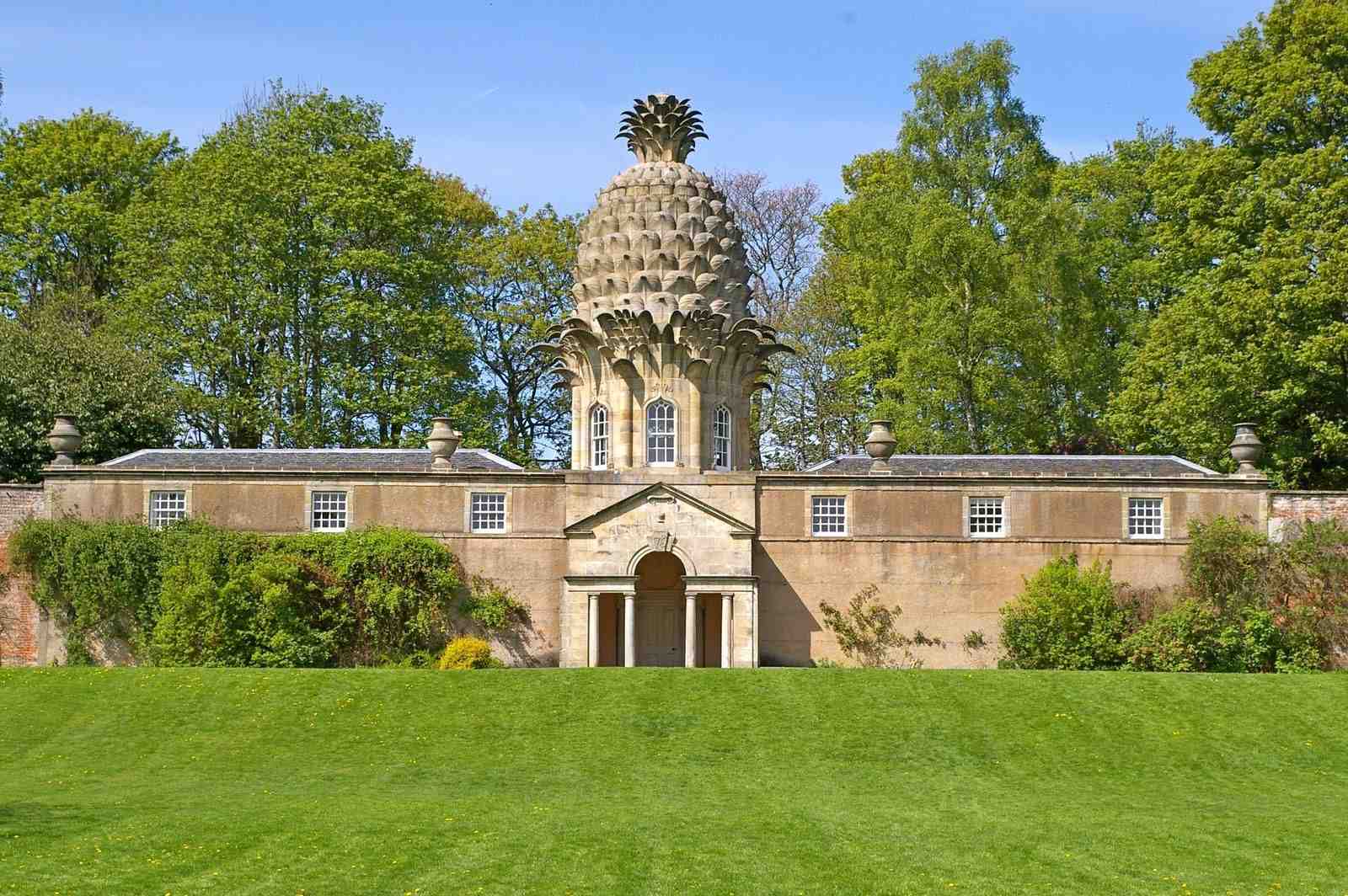
Dunmore Pineapple
Dunmore Pineapple is a Pineapple inspired building built by Lord Dunmore in the 18th Century. Sailors returning home in this era would often put a Pineapple on their gatepost as a symbol to the community that they had returned home and would welcome visitors.
No one knows exactly why Lord Dunmore built this summer house however it is often thought that perhaps Lord Dunmore wanted to tell everyone that he had returned home after serving as the governor of Virginia.
The building is free to visit and has a large lawn in front of the building which you can explore as well as a woodland walk around the property. There is even a path to Elphinstone Tower.
If you want to go into the building it is possible to stay in the Pineapple folly, the property is maintained by the Landmark trust. The property sleeps 4 (a twin and a double room). This can be booked by visiting the Landmark Trust website. A 4 night stay costs from £320.
How to get there?
The Dunmore Pineapple is located 7 miles from Stirling and 33 miles from Edinburgh. If travelling by car from Stirling follow the A905 road and turn right when sign posted before Airth village. Also if travelling from Edinburgh take the M9 Motorway and exit at junction 7. Follow the M876, at junction 3 take the A905 exit to Airth. Finally you go through the village of Airth take a left when sign posted. There is then a dirt track towards the small car park. This has capacity for only a small number of cars. It should also be noted that the track has a number of pot holes so it is advised to drive with care.
Other attractions in the area that are worth visiting are; The Falkirk Wheel, The Kelpies and Stirling Castle.