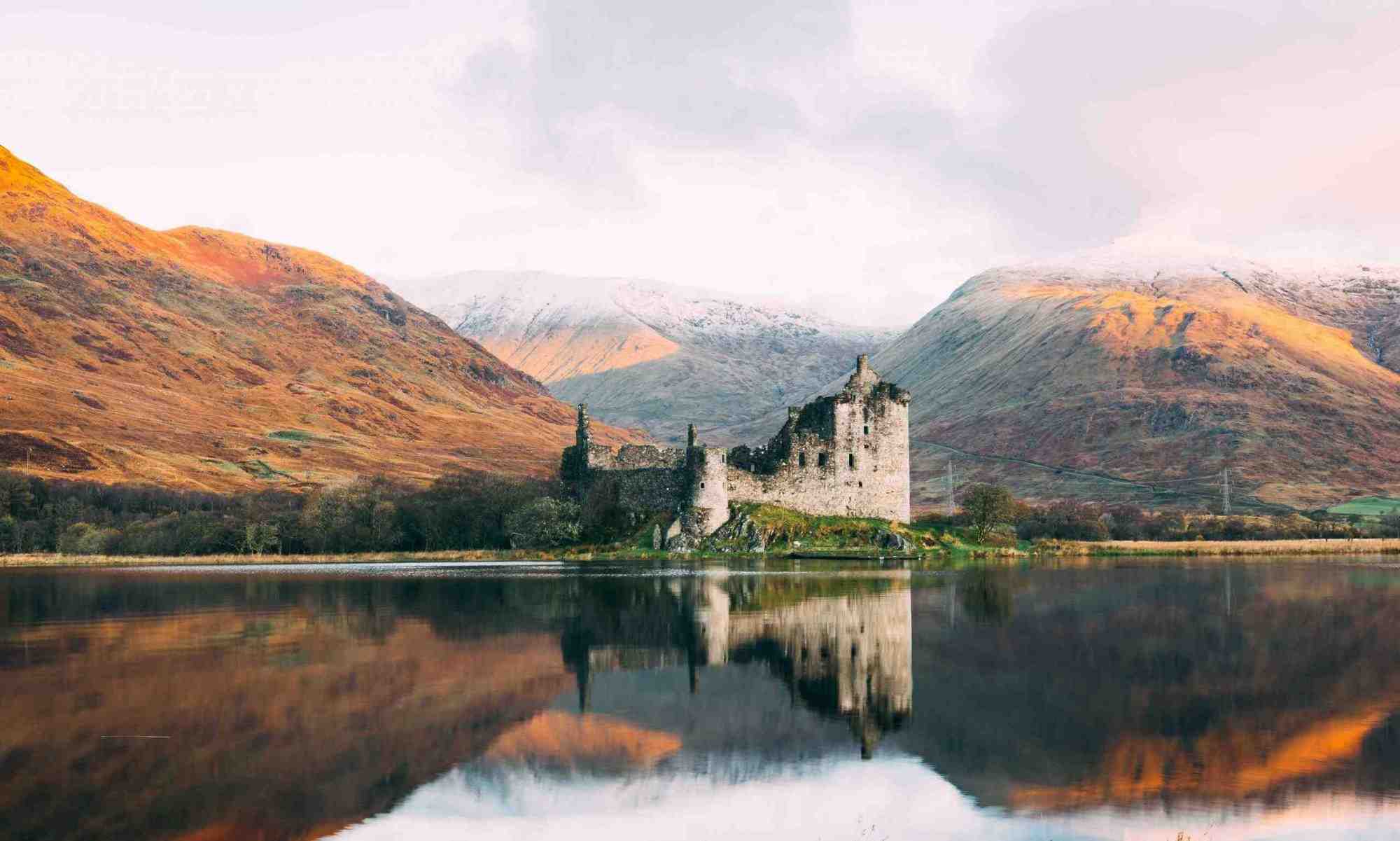

Kirkcaldy is the largest town in Fife, strung out along the coast of the Firth of Forth about an hour north of Edinburgh. Locals call it the Lang Toun — the long town — because its main street once ran for close to four miles in an almost unbroken line along the shore, and the name has stuck for centuries.
It is not a picture-postcard Scottish town, and it does not pretend to be. Kirkcaldy is a working place with an industrial past, a superb art collection, a long beach, and a genuinely interesting history that includes the man who effectively invented modern economics. For travellers willing to look past the tourist trail, it makes a rewarding day out and an easy stop between Edinburgh and the East Neuk.
Getting to Kirkcaldy
Kirkcaldy is straightforward to reach, which is one of its advantages over the prettier but more awkward villages further east.
By train — Kirkcaldy is on the main Edinburgh to Dundee and Aberdeen line. Trains from Edinburgh Waverley take around fifty minutes and run frequently throughout the day. The station is a short walk uphill from the town centre.
By car — from Edinburgh you cross the Queensferry Crossing and follow the M90 and A92, which takes roughly forty-five minutes to an hour depending on traffic. There is parking in the town centre and along the Esplanade.
By bus — regular coach services connect Kirkcaldy with Edinburgh, Glasgow and other Fife towns.
Adam Smith and the town’s most famous son
Kirkcaldy’s biggest claim on world history is that Adam Smith was born here in 1723, and wrote much of The Wealth of Nations here after returning to live with his mother. The book, published in 1776, laid the foundations of modern economics, and a good deal of it was thought through on walks along this coastline.
There is a memorial to Smith in the town, and the Adam Smith Theatre — a busy venue for drama, comedy and music — carries his name. The town has also produced the architect Robert Adam, whose neoclassical style shaped great houses across Britain, and in more recent times Gordon Brown, who served as the town’s MP before becoming Prime Minister.
Kirkcaldy Galleries
If you do one thing in Kirkcaldy, do this. Kirkcaldy Galleries holds an art collection out of all proportion to the size of the town, built up largely through the gift of local linoleum manufacturer John Nairn.
The strength of the collection is Scottish painting. There is an outstanding body of work by William McTaggart, whose loose, weather-driven seascapes prefigured Impressionism, and a fine group of Scottish Colourists — most notably S. J. Peploe. For anyone with an interest in Scottish art it is one of the best collections outside the national galleries, and entry is free.
The building also houses the town museum and the central library, with displays covering Kirkcaldy’s industrial history, and there is a café. Check current opening days before travelling, as these have changed over the years.
Ravenscraig Castle
On a rocky promontory at the eastern end of town stand the ruins of Ravenscraig Castle, begun in the 1460s for Mary of Guelders, queen of James II. It has a decent claim to being one of the first castles in Britain designed from the outset to withstand artillery, with immensely thick walls and gunports rather than arrow slits.
The ruin is open to the public, free to visit, and sits in a park above the sea with views across the Forth. It featured as a location in the Outlander television series, which brings a steady trickle of visitors — see our guide to Outlander filming locations in Scotland for the wider trail.
The Esplanade and the beach
Kirkcaldy’s seafront promenade runs for roughly a mile and a half along the shore, backed by a long sand and shingle beach. It is an unfussy, breezy place for a walk, with views over the Firth of Forth towards Edinburgh and the Lothians on a clear day.
For two weeks each April the Esplanade is taken over by the Links Market, which claims to be the longest street fair in Europe. It has run since the twelfth century and now fills the entire promenade with rides and stalls. If you happen to be in Fife in April it is worth seeing; if you are looking for a quiet coastal walk, avoid that fortnight entirely.
Dysart
At the north-eastern edge of Kirkcaldy lies Dysart, an old harbour village that was once a separate burgh and is now the most attractive corner of the town. Its restored harbour, pantiled cottages and the tolbooth make it feel closer to the East Neuk fishing villages than to the town it belongs to.
Dysart harbour stood in for the French port of Le Havre in Outlander, and the village sits directly on the Fife Coastal Path, making it an easy and rewarding short walk from the town centre.
Beveridge Park and green space
Beveridge Park is a large Victorian public park with a boating lake, formal planting and open lawns, given to the town in the 1890s. It hosts events through the summer and is the obvious place to take children on a decent day.
Ravenscraig Park, next to the castle, is the other main green space, with woodland paths dropping down towards the sea.
The linoleum town
For roughly a century Kirkcaldy was the world capital of linoleum manufacture. At its height the town had several large floorcloth factories, and the smell of linseed oil hung over the whole place — memorialised in Mary Campbell Smith’s much-quoted poem about “the queer-like smell” that told travellers they were nearly home.
The industry is long gone and most of the works have been demolished, but it shaped the town’s wealth, its architecture and its art collection. The displays in Kirkcaldy Galleries tell the story properly, and it is worth understanding before you walk around — a lot of the grander buildings make more sense once you know where the money came from.
Eating, drinking and practicalities
Kirkcaldy is a working town rather than a tourist centre, and its food scene reflects that: plenty of straightforward cafés, bakeries, chip shops and pubs, a handful of good independent restaurants, and the usual high-street chains. The area around the High Street and the streets running off it is where most of it is concentrated, and you will not need to book ahead outside of event weekends.
The town is an easy day trip, so most visitors stay elsewhere — Edinburgh, St Andrews or one of the East Neuk villages. If you do want to stay locally there are hotels and guest houses in and around the town, and prices are considerably gentler than across the Forth.
A few practical notes. The town centre is compact and walkable, but it sits on a slope above the shore, so the walk between the station, the High Street and the Esplanade involves a bit of a climb. Most of the main attractions — the galleries, the castle, the beach — are free, which makes Kirkcaldy an unusually cheap day out. And as anywhere on this coast, the wind off the Forth is a real consideration; the Esplanade is exposed, and a still day here is a rare gift.
Where to go next
Kirkcaldy works well as part of a wider Fife trip rather than a destination in itself.
West along the coast, Burntisland has a fine sandy beach and a remarkable sixteenth-century church, and Aberdour is one of the prettiest villages on this stretch, with a medieval castle and the Silver Sands beach. Inland, Dunfermline was Scotland’s ancient capital, with an abbey holding the grave of Robert the Bruce and the birthplace cottage of Andrew Carnegie.
Heading east takes you into the East Neuk and on towards St Andrews. South across the Forth are the Lothians and Edinburgh itself.
Is Kirkcaldy worth visiting?
Honestly, it depends what you want. If you are on a short first trip to Scotland with a week to spend, Kirkcaldy will not make your itinerary and should not — the Highlands, Edinburgh and Skye have stronger claims on limited time.
But if you are staying in Fife, travelling with an interest in Scottish art, following the Fife Coastal Path, tracing Outlander locations, or simply curious about ordinary Scottish towns rather than the postcard version, it repays a day. The art collection alone justifies the train fare from Edinburgh.
This guide is part of our complete Kingdom of Fife travel guide — explore St Andrews, the East Neuk villages, beaches and more.
Frequently asked questions
How far is Kirkcaldy from Edinburgh?
Around 25 miles by road, or about fifty minutes by direct train from Edinburgh Waverley. By car it is typically forty-five minutes to an hour via the Queensferry Crossing.
Why is Kirkcaldy called the Lang Toun?
Because the town developed as a single long street running parallel to the shore, at one point stretching close to four miles. The nickname dates back centuries and is still in everyday use.
What is Kirkcaldy famous for?
Adam Smith, who was born here and wrote The Wealth of Nations here; linoleum, which the town manufactured on a world scale; and the Links Market, Europe’s longest street fair.
Is Ravenscraig Castle free to visit?
Yes. The ruins sit in a public park and can be visited free of charge, though the interior access is limited as it is an unstaffed ruin.
How long do you need in Kirkcaldy?
Half a day covers the galleries, the Esplanade and Ravenscraig. A full day lets you add Dysart and the coastal path, or combine it with one of the neighbouring Fife towns.